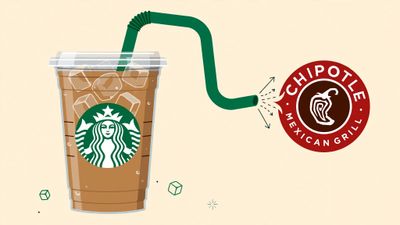
The FT reports Starbucks explored a $39B Chipotle takeover. Our take: it would be brilliant.
Breakfast burritos at Starbucks, real coffee and beverages at Chipotle, and the morning daypart will never be the same.
The Financial Times reported Thursday that Starbucks has explored a takeover of Chipotle Mexican Grill, working with advisers on a potential proposal. No formal offer, and it may never happen. But the market already voted: Chipotle surged 8.6%, the S&P 500's top performer, while Starbucks fell.
The numbers are staggering. Chipotle is worth nearly $39 billion. At anything near that, it's the largest restaurant deal in history, tripling Burger King's $11.4 billion Tim Hortons buy. Together they'd do nearly $50 billion in sales: 41,000 Starbucks stores, 4,200 Chipotles.
Then the human story. Starbucks CEO Brian Niccol ran Chipotle from 2018 to 2024, doubling sales and fixing the food safety crisis. He knows the operations, the culture, the people, including current CEO Scott Boatwright, who was his COO. Nobody could integrate these companies better than the man who has led both.
Photo: Starbucks
Our take, stated plainly: this would be brilliant. Here's why, and here's the math.
The breakfast unlock
Chipotle has barely served breakfast. It tested a menu at two airport locations years ago and never rolled it out. Starbucks, meanwhile, owns the morning: the commute coffee, the pastry case, the mobile order.
Put a coffee program built for the fight, fast, customizable, and priced to take on Luckin, Dutch Bros, and McDonald's, alongside breakfast burritos, breakfast tacos, and pastries in 4,200 Chipotles, and the chain stops being lunch-and-dinner. It becomes an all-day habit. Run it the other way, Chipotle burritos in Starbucks pastry cases, and 41,000 stores become sampling stations. Each brand acquires customers for the other, almost free.
The metric that matters: visits per customer per month. Breakfast doesn't just add a daypart. It pulls the regular in earlier and more often.
The beverage unlock
Here's the bigger daypart nobody talks about. Chipotle's beverage program is fountain soda and nothing. Its dining rooms sit empty at 3pm.
But the drink run is Gen Z's default outing. Dutch Bros built a nearly $2 billion business on energy drinks and customization. Starbucks' Refreshers grow at double digits and carry its entire afternoon. Beverages are the highest-frequency, highest-margin visit in food service, and Chipotle captures zero of it.
Photo: Design Your Way
Starbucks fixes that on day one: Refreshers, energy, cold brew in 4,200 locations. Chipotle gets an afternoon daypart it never had. Starbucks gets 4,200 new points of distribution for every drink it invents. And the 19-year-old finally has a reason to walk in at 3pm.
The coffee war
Now the urgent part. In March, Centurium Capital, Luckin's controlling shareholder, bought Blue Bottle Coffee for under $400 million. One owner now holds the $1.99 value cup and the premium pour-over. That is not a coffee company. It is a full-spectrum assault on the middle where Starbucks lives.
Count the fronts. Luckin owns value and technology, with 36,000-plus stores and a growing US footprint. Its new sister Blue Bottle owns premium ritual. Dutch Bros owns youth culture and the drive-thru lane, does $2.1 million per store, and is adding food. McDonald's owns the mass morning. Four attackers, four occasions, one target in the middle.
Starbucks cannot build its way out. A new store takes a year to site and open. Luckin opens hundreds annually. By the time Starbucks builds 4,200 coffee-competitive locations, the war is over. The only way to get them overnight is to buy them.
So Chipotle becomes the counter. Not a Reserve bar, a fighting brand: quick-service coffee with real customization, energy options for the afternoon, prices that meet Luckin without racing it to the bottom. Starbucks has the arsenal. Chipotle is the battlefield. You don't beat a pincer by defending the middle. You build a bigger one.
Illustration: LAeats
Why now
Timing is clean. Chipotle's stock is 20 percent off its highs, so Starbucks buys the dip. The $4 billion China sale, once closed, funds the move. The competitive threat just got real. And Niccol, thirteen months into the job and coming off the turnaround's best quarter, negotiates from strength. Wait two years and the window shuts.
The math
At a 10 to 17 percent premium, the deal is about $44 billion, funded with Starbucks stock, cash, and debt. Here's how it pays.
Chipotle does $13 billion across 4,200 stores. A real breakfast program at 12 percent of sales: roughly $0.9 billion in new profit by year five. The beverage platform: another $0.6 billion. Doubling toward 8,400 stores plus same-store growth: $2.1 billion. Better breakfast and food at Starbucks: $0.9 billion. Modest corporate synergies: $0.2 billion. Combined EBITDA goes from $7.8 billion to about $12.5 billion, up 60 percent. All figures illustrative.
Illustration: LAeats. Projections are illustrative.
On the sticker, Starbucks pays 20 times Chipotle's current EBITDA. Full price. On year-five numbers, the multiple drops into the low teens. Full price for the company, a discount for the growth.
The combined equity goes from $146 billion today to roughly $242 billion, about two-thirds upside, before any re-rating. And the market loves a growth story: if it values the combined company the way it valued these two in their growth eras, the number starts with a three.
Illustration: LAeats. Projections are illustrative.
Double in five years
Chipotle sees a path to 7,000 stores. Go further: double to 8,400 in five years, mostly outside the US, on Starbucks' international machine. Eight hundred-plus net new stores a year, each paying back in under two years. By 2031, Chipotle is a $30 billion global brand. Execution is the risk, but even at half the international pace, the dayparts carry the model.
More ways to win
One loyalty currency across 45,000 stores. Chipotlane coffee express lanes. Ghost kitchens in Starbucks back rooms, with automated bowl assembly for delivery and no new leases. Chipotle products on Starbucks' grocery shelf. The two earliest app believers in food service, combined into one digital moat. And an innovation engine: Chipotle built and killed concepts like Farmesa in Santa Monica for a decade. Give that team a Starbucks budget.
Photo: @laeats
Photo: @laeats
Photo: @laeats
The other side
None of it has happened yet. No formal offer. Starbucks stock fell on the news: the turnaround is unfinished, the price is enormous, and mega-mergers die on integration, though no acquirer has ever arrived this hedged. Earnings dip in year one before the deal turns accretive.
Could Starbucks build it all for less than $44 billion? In theory. In practice you can't buy 4,200 kitchens, a decade of food R&D, and five years. The build option saves money and costs the window.
What this means
Watch whether flirtation becomes an offer. If Starbucks moves, the coffee giant becomes a food giant, the burrito chain becomes a breakfast chain, and the industry gets a new template: you don't need to invent breakfast. You need one perfect acquisition and 41,000 stores to put it in.
We reached out to Starbucks for comment on the FT report and will update this piece with their response.
Sources: Financial Times via Reuters, Oct 8, 2026; Barron's; Semafor. Financial figures: company filings via Finnhub, WallStreetZen, Barchart. Projections are illustrative.