At $295 a person, Seline isn't cheap. But Dave Beran's Santa Monica tasting menu is the rare LA fine-dining experience where the math actually works.
Dave Beran's Santa Monica tasting menu is $295 a person. Here's why it's the rare fine-dining experience in LA that actually earns the price tag.
At $295 a person, Seline isn't cheap. But Dave Beran's Santa Monica restaurant is the rare LA fine-dining experience where the math actually works — and the hype undersells the experience.
By LAeats · April 2026
The entrance on Main Street. Beran describes Seline as feeling like you're walking in through a back door — "the way friends always came in at my grandparents' house."
The case against the modern tasting menu is easy to make, and most of it is true.
Three hundred dollars for a parade of tweezered bites. Servers who describe "journeys" instead of dinners. Courses engineered for Instagram and sized for a sparrow. You leave hungry, lighter in the wallet, and vaguely aware you should have gone to a good taco stand instead — which, in Los Angeles, is an especially damning alternative. The tasting menu, at this point, is fine dining's most reliably overhyped format. The backlash is earned.
And yet.
Last Saturday, we sat down for fourteen-plus courses at Seline, Dave Beran's Santa Monica restaurant on Main Street, and by the time the sorrel-blackberry-olive oil closer landed on the table, we were already debating — midway through, no less — which dish was our favorite. We couldn't decide. We still can't. That's the review. Everything else is just explaining why.
At $295 per person before beverages, Seline is not cheap. It is also, we are now confident in saying, the tasting menu in Los Angeles actually worth the money in 2026. Here is the full argument.
The Context: Why Tasting Menus Deserve the Skepticism
LA's relationship with the multi-course tasting menu has always been complicated. The city that gave the world carne asada fries and Kogi trucks has never really been a natural fit for the silent-reverence-plus-tweezers school of dining. When Vespertine first opened, the joke was that you needed a translator. When Somni reopened, the reservations-and-hype cycle felt like a parody of itself.
The format's critics are right about a lot of things. Portions are often absurd. Pacing can be glacial. Pretension is rampant. And the value math rarely works out — a great steakhouse dinner or a legendary sushi omakase usually delivers more pleasure per dollar than the average 20-course tasting, which asks you to sit through seven okay things to get to three transcendent ones.
So when we tell you Seline is worth it, we mean it against that backdrop. Not worth it "for a special occasion." Not worth it "if you love fine dining." Worth it, period — as in, the math works, and the hype undersells the experience.
The Chef: Dave Beran Is Operating at a Different Level
Chef Dave Beran at the pass. Seline's open kitchen puts the chef and his team within arm's reach of nearly every seat in the 38-seat dining room.
A little background matters here. Beran spent years as chef de cuisine at Alinea in Chicago under Grant Achatz, then ran the kitchen at the James Beard Award-winning Next before moving to Los Angeles and opening Dialogue in 2017. Dialogue earned a Michelin star and then closed during the pandemic. Pasjoli, his French bistro a few blocks from Seline on Main Street, earned its own Michelin star and is still one of the best restaurants in the city.
Most chefs with that resume coast. Beran did the opposite. He has described Seline as more mature than his previous work — less about the bells and whistles, more about stripping dishes down and creating opportunities for guests to engage with the people at the table. In practice, that means a restaurant that has the technical rigor of an Alinea alum but none of the aloofness. The kitchen is open. The staff are warm. The plating is dazzling without being precious. It's fine dining that remembers it's supposed to be fun.
We already considered Beran one of LA's best chefs before this dinner. Seline didn't change that opinion so much as raise the ceiling of what we thought was possible for him.
The Menu: Spring, 2026
Here's what the Spring menu looked like on Saturday, April 18 — fourteen-plus courses plus amuses and mignardises:
- Succulent · avocado · burnt parsley
- Green Garlic · artichoke · eucalyptus
- Dungeness Crab · kohlrabi · bay laurel
- Beef Tendon · fennel pollen
- White Asparagus · farro · black trumpet
- Preserved Cherry · pistachio
- Celery Root · smoked beet · savory granola
- Celery Root · miso fudge
- Maitake · rose
- Tuna · fermented poblano
- Rhubarb · ginger · sakura
- Green Asparagus · sunflower
- Peas · fava bean · shio koji
- Black Cod · mussel · fennel
- Cauliflower · wild greens · burnt strawberry
- Brioche · butter
- Coffee · caviar
- Caramelized Honey · earl grey tea · lemon
- Sorrel · blackberry · olive oil
Reading the menu is one thing. Eating it in sequence is another. Beran structures his menus not as a parade of isolated dishes but as a narrative — ingredients recur across courses, textures echo and contrast, and a single thread (fennel, for example, sourced from a previous season and carried forward) runs through the meal in ways you notice only in retrospect. It is one of the only tasting menus we've sat through where by dish nine, you start to understand what the chef is actually saying.
The entire menu spoke to spring so strongly that it made us think about the other three seasons we hadn't yet tried. That's not a throwaway line — that's the best thing a seasonal tasting menu can do. You leave already planning your return.
The Dishes: Where the Money Goes
Singling out favorites is nearly impossible. We were trying to do it midway through the meal and failing, which should tell you everything. But a few courses are worth calling out specifically, because they are the kind of dishes that justify the format's existence.
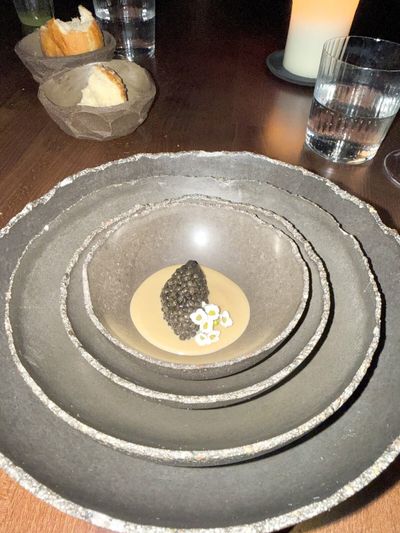
The signature caviar course: coffee ice cream topped with a generous quenelle of golden osetra, delivered to the table by Chef Beran.
The caviar course. Beran personally delivered this one to our table — a scoop of coffee ice cream topped with a generous quenelle of golden osetra, finished with tiny white flowers, set inside a nest of stacked ceramic bowls. The chef's signature golden osetra caviar served atop hazelnuts and a coffee anglaise is the ultimate ending — and it is exactly as outrageous and exactly as right as it sounds. The caviar Seline serves is sourced from a farm using no-kill harvesting methods, custom-cured for the restaurant, from fish raised without being killed to produce the roe. It's the kind of sourcing detail most restaurants wouldn't bother explaining; at Seline, it's the rule, not the exception. The dish itself — coffee, cream, salt, brine, temperature contrast, visual drama — is the single most memorable thing we've eaten in Los Angeles in a long time.
"The dish itself is the single most memorable thing we've eaten in Los Angeles in a long time."
The black cod, beautifully poached, in its now-iconic brushstroke bowl — hand-thrown by Match Stoneware in Culver City.
The black cod. Beautifully poached, served in a wide, hand-thrown white bowl dragged with a single sweeping black brushstroke of glaze. The fish sits in a small pool of fennel-mussel sauce in the center — silky, delicate, cooked to the precise texture where the flakes just barely hold. It looks like a sumi-e painting. It tastes like the ocean at its most generous. The bowl alone — custom-made for the restaurant — would be the centerpiece of a lesser meal.
The maitake. Plated like a chicken wing and served with a house-made sweet and sour sauce. On paper it reads like a joke, or a callback to some diner food memory filtered through a Michelin-starred kitchen. On the plate it's something else entirely — a wild, confident combination of flavors and textures that shouldn't work and absolutely does. Crisp edges, meaty center, a glaze that walks the line between tangy and sweet. It's the course that most clearly shows Beran's sense of humor and his refusal to be precious about fine dining. We are still thinking about it.
The beef tendon, fried to a crackling puff and dusted with fennel pollen — mounted on a charred wood block with the dried fennel flower stems from which the pollen came.
The beef tendon. Puffed and crisped to a light, crackling golden texture, dusted with fennel pollen, mounted on a charred wood block with the dried fennel flower stems from last season rising above it like a small still life. It's one of the clearest examples of Beran's ingredient-over-time philosophy: the pollen comes from fennel sourced in a previous season, preserved and deployed now — with the original dried flower presented alongside it as a kind of provenance. Tendon is one of those ingredients most American fine-dining kitchens won't touch — too unfamiliar, too risky, too far from what a $295 guest supposedly wants. Beran doesn't care. The course lands with the confidence of a chef who knows exactly what he's doing and trusts the room to come with him. We did.
Peas, fava bean, and shio koji — spring at its most essential, in a cracked-glaze Match Stoneware bowl.
The peas, fava bean, shio koji. An emerald-green vegetable course in a cracked-glaze bowl that looks like it was dug out of a riverbed. This is the kind of dish that sounds modest on the menu and arrives as the purest distillation of spring you'll eat all year.
The sunflower presentation. The course where our table went quiet.
The sunflower presentation. A golden-brown fritter nested inside the actual yellow petals of a sunflower, served on a glass dish. It is the course where the table went quiet. Beran is playing with form — is it a flower, is it food, is it both — and the answer is yes.
The cauliflower course, with wild greens, green herb purée, and a single burnt strawberry. The brioche (in background) arrives late in the meal.
The cauliflower. Roasted, crusted, plated with wild greens, a swoosh of green herb purée, and a single burnt strawberry. A course that reminds you what a vegetable can do when a three-Michelin-star-trained chef decides to take it seriously.
The brioche. A warm, golden brioche donut with butter — the single best bread service we've had, anywhere. What makes it remarkable isn't just the bread itself, though the bread itself is perfect. It's where Beran places it on the menu. Most restaurants bring bread service at the start, as a holdover from the French bistro tradition. Beran puts it late in the meal, right before the dessert courses begin, where it functions as a quiet transition — a moment of warm, familiar comfort between the savory arc and the sweet finale. It's the kind of structural choice that reveals how deeply he's thought about the shape of the whole meal. A lesser chef would have served it first. Beran understood it belonged at the turn.
Every course was layered — not just with flavor, but with texture. Crunch against cream, heat against chill, acid cutting fat, something fermented playing against something fresh. This is what separates Beran from the tasting menus people rightly complain about: at Seline, no course is filler. Every plate does real work.
The Room, the Garden, the Plateware
Designed by Rugo/Raff Architects — the same firm behind Alinea in Chicago. Nearly every seat has a clear view of the pass.
The physical experience of Seline is its own argument. Designed by Rugo/Raff Architects — the same firm behind Alinea in Chicago — the space is elegant but not stuffy, with soft lighting, walnut tables, and navy banquettes. The kitchen is fully open; nearly every seat has a clear view of the line. You watch Beran work. You watch the plating. The line between guest and staff is intentionally porous.
You enter through a garden — a working herb and flower garden that wraps the patio and entrance. Much of what you'll eat was picked steps from where you're sitting. Beran grows herbs, edible flowers, and garnishes on site and rotates them through the menu. This isn't farm-to-table as a marketing line; it's the restaurant's actual supply chain for the small, precious things.
And the plateware. Every single bowl and plate at Seline is custom-made for the restaurant by Match Stoneware, the Culver City ceramics studio that also makes dinnerware for Vespertine, Somni, and Destroyer — which is to say, essentially every serious tasting menu in Los Angeles is plated on Match. The black-brushstroke cod bowl. The cracked-glaze pea bowl. The layered concentric-ring setting for the caviar service. The rough-textured stoneware with a perfect circular well cut into the center. These are hand-thrown, hand-glazed, one-of-one pieces. They are the kind of things you'd see at a gallery. Each one was designed for a specific course. Once you notice it, you can't stop noticing it.
Caramelized honey, earl grey, and lemon — late in the meal, served in a cloud-patterned Match Stoneware vessel. The wooden moss-nested bowl beside it holds a separate preparation; every service element is its own sculpture.
The Pacing
This one is harder to describe, and it's the detail that separates a good tasting menu from a great one.
The timing of the meal was impeccable. Course after course, for over three hours, the pacing never slipped — not once. No gaps where you're sitting with an empty plate wondering if the kitchen forgot about you. No stretches where plates arrive too quickly and you feel rushed through something you wanted to linger over. Just a steady, confident rhythm that kept us fully in the experience from the first bite to the last.
"Pacing is the invisible craft of a tasting menu. When it works, you don't notice it — which is exactly the point."
There's no way to properly explain how much this contributed to the meal feeling perfect. Pacing is the invisible craft of a tasting menu. When it works, you don't notice it — which is exactly the point. You notice the food, the room, the conversation at your table, the chef at the pass. You don't notice that a team of people is orchestrating twenty courses across a dining room full of tables, each at different stages of the same journey, all timed precisely. At Seline, that choreography was flawless. It's the kind of thing you only really appreciate after you've sat through enough bad tasting menus — the ones where you're either starving between courses or overwhelmed by two plates landing on top of each other — to understand how rare it is.
The Beverage Program
Beverage Director Matthew Brodbine's pairings are a parallel experience — both the wine list and the non-alcoholic program are worth the add.
Beverage Director Matthew Brodbine, who also runs the program at Pasjoli, created two pairings: a wine pairing drawing from forward-thinking producers around the world, and a non-alcoholic pairing of house-made drinks where — in Beran's words — nothing is just a tea or just a juice. The wine pairing is $225 per guest, the non-alcoholic pairing $165, and a hybrid option splits the difference at $195.
We've had drinks made by Brodbine before and they are some of the most thoughtful we've had in LA, often leveraging ingredients already moving through the kitchen — byproducts, trim, ferments — which is both deeply clever and deeply sustainable. If you drink, add the pairing. If you don't, add the non-alcoholic. It is the rare pairing program where the zero-proof version is not a concession; it's a separate, fully realized experience.
The closing course: sorrel, blackberry, olive oil — finished with wood sorrel leaves and shiso from the garden steps from your table. The final plate of the Spring menu.
So, Is It Worth $295?
Here is the math. For two people without pairings, you're at $590 before tax and tip. Add wine pairings and you're at $1,040. All-in with tax and a 25%+ tip, two people doing wine pairings are looking at roughly $1,300 for the evening.
That is a lot of money. It is also — and this is the part the skeptics never want to hear — less than you'd pay at Vespertine, at the top-tier sushi omakases in town, or at most three-Michelin-star restaurants anywhere in the country. And unlike most of those rooms, Seline gives you fourteen-plus courses of genuinely inventive cooking, a beverage program that's a restaurant unto itself, custom tableware, a working garden, and a chef who might walk a course to your table.
Can you eat better in Los Angeles for less money? Absolutely. You can have the best tacos of your life for $15. You can eat a spectacular dinner at a dozen neighborhood restaurants for a third the price. LAeats has covered — and will keep covering — those places religiously.
But that's not what a tasting menu is for. A tasting menu is for the nights when you want to see how far a single chef can push a single idea across three hours. On that specific metric, at this specific moment, Seline is the one. It's the tasting menu in LA that earns its price tag. It's the one we'd send a visiting out-of-towner to. It's the one we'd go back to in summer, fall, and winter to watch the menu change.
"We went in ready to be the skeptics. We left already trying to figure out when we could go again."
We went in ready to be the skeptics. We left already trying to figure out when we could go again.
Quick Facts
Seline
3110 Main St, Suite 132, Santa Monica, CA 90405
Chef
Dave Beran (also of Pasjoli; formerly Alinea, Next, Dialogue)
Format
14–18 course seasonal tasting menu
Price
$295 per person · wine pairing $225 · non-alcoholic pairing $165 · hybrid $195
Large Parties
Groups of 7–12 at a dedicated table with a 10–12 course menu, same $295 price
Hours
Tuesday–Saturday, dinner only
Reservations
OpenTable (deposit required)
Website
selinerestaurant.com
Have thoughts on LA's tasting menu scene? We're working our way through the full list this year. Seline is our first full review. Send us your arguments, disagreements, and recommendations.