Five nights, 100 seats, $954 a head: Chef Masa Takayama's homecoming residency at The Peninsula Beverly Hills was the hardest dinner reservation in LA this year. Our full review.
Chef Masa Takayama came home to Beverly Hills for five nights — and proved what a Master Chef really means: decades of excellence, focus, simplicity, and a meal beyond words.
Last week, one came home to Beverly Hills. In a world full of "the best" and "must-try," there is something to say for decades of excellence and experience. A Master Chef has a true meaning. Chef Masa is how you know it's still alive.
By LAeats · September 2026
The T.C. Toro tartare crowned with caviar in a chilled coupe. Our opening shot.
Some dinners you review. Some dinners you just witness.
Last week, on a terrace in Beverly Hills, Masa Takayama, 71 years old, the chef who invented the modern American omakase counter in this exact zip code and the first Japanese chef in America to earn three Michelin stars, came home. The residency was called "Masa Returns to Beverly Hills," timed to the Peninsula's 35th anniversary. Five nights. A ten-seat counter. Fifteen-plus courses.
We are not going to do the skeptical routine on this one. There is no case against it. What his team put on that counter was a meal beyond words. Ingredient-obsessed and flawlessly executed, it pulled the rarest trick a sushi omakase can manage: it left us completely, happily full.
The Homecoming
To understand why this mattered, you have to understand what Los Angeles was when Masa Takayama got here.
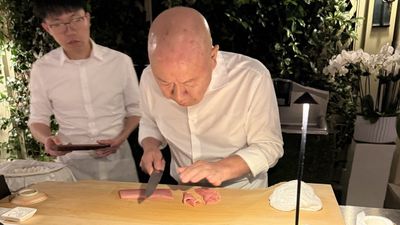
The master himself. Masa Takayama, 71, at the counter, the man the whole night was about.
He arrived in 1980 after an eight-year apprenticeship at Tokyo's Ginza Sushiko, opened a small spot called Saba-ya, and then, in 1987, opened his own Ginza Sushiko in Beverly Hills: a nine-seat counter, omakase only, no compromises, at a time when sushi in America still mostly meant a California roll at the edge of a strip mall. That tiny room became one of the most obsessed-over reservations in the city. Marlon Brando came after hours with his family. A decade later Takayama sold it to his sous-chef, who renamed it Urasawa, and left for New York.
Everything about modern American omakase runs through that room. The counter as theater. The omakase-only format. The refusal to dumb anything down for an American audience. He proved, in Beverly Hills, that it could work, then spent the next twenty years proving it again in New York, where his restaurant Masa became the most decorated sushi counter in the country.
He doesn't do pop-ups. He doesn't need to. So when the Peninsula announced five nights for its 35th anniversary, it didn't feel like a residency. It felt like a visit from the relative who made it big and finally came home for dinner to cook.
Credit where it's due: this was the Peninsula's idea, and it was a great one. For a 35th anniversary, most hotels book a DJ. The Peninsula brought home the most important sushi chef in America. Nick Shultz, the hotel's director of food and beverage, secured Masa for the five-night run.
The Approach: Focused, Simple, Perfect
The work, up close. Toro sliced to order at the counter, a few feet from where you sit.
Strip everything away and this is the story of the night: focus, simplicity, and the highest-quality ingredients and techniques on earth.
Takayama's philosophy has never changed, and he has never dressed it up. Asked what makes great sushi, his answer is immediate: the most important thing is the rice. Asked about his style: solid, no bullshit. Ingredients, ingredients, ingredients.
Simplicity is the hardest discipline in cooking. When the ingredient is the whole dish, there is nowhere to hide. No sauce to fix it, no garnish to distract you. Every piece of fish on that counter was the best version of itself: the tuna lingot from Norway, the langoustine from Norway, the sushi fish brought in from the Hokkaido fish market, Hokkaido uni from Marutaku Suisan sitting out in a full wooden tray like a still life. The toro was sliced seconds before it was served, and the wasabi was grated to order on a beautiful metal grater instead of sharkskin, which is better and more sustainable. And the technique is what turns great ingredients into something beyond words: the rice, seasoned and temperature-controlled to a degree that has become legend among sushi chefs. He even shared with us that different fish call for rice at different temperatures, the kind of detail you only learn from decades at the counter. Focus. Simplicity. The highest quality, treated with the highest technique. That is the whole story.
The night's fish, presented before service.
His design sensibility runs on the same principle. The Masa Designs tableware line is built on shibui, quiet elegance and restraint, with just enough complexity to keep you paying attention. Black lacquer, blue-and-white porcelain, chilled glass. Every course arrived in its own frame, and none of the frames ever upstaged the food.
The Team: A True Master and True Apprentices
Masa Takayama is a true master sushi chef, and you could see it in his team. A master is only as real as the apprentices he has taught, and his team worked that counter like people who learned from the best.
His apprentices at work, building the T.C. course a few feet from the guests.
Hands at work, forming nigiri to order.
The counter was run by Takayama's apprentices, young chefs in white shirts working in near-silence a few feet from where you sat, moving with the calm precision of people who were taught properly. Watching two of them build the toro-caviar coupes, spooning toro tartare into chilled glass, finishing each with caviar, wiping the rim, was half the pleasure of the course itself. That is what good teaching looks like: the master's standards, executed by hands he trained.
The master and an apprentice, side by side at the counter.
This is the apprenticeship tradition, alive. Sushi is passed hand to hand, the way Takayama himself learned it in eight years under Sugiyama Toshiaki at Ginza Sushiko. Nothing rushed, nothing stalled. Courses landed one at a time, each one seconds old, the rice still warm. At a ten-seat counter there is nowhere to hide: no pass, no expo line, no distance between the hands that make the food and the people eating it. The team never blinked. He has taught them well.
Two apprentices finishing the small courses.
The counter, from the chef's side.
Shaping nigiri at the outdoor counter.
His name, on the board. Courses landed on a wooden geta engraved with "Masa," the kind of detail you only notice when you're sitting close enough to read it.
The Menu: Fifteen-Plus Courses
Here's what the evening looked like, reconstructed from the hand-illustrated take-home menu the team sent guests home with and the kitchen's own course notes. Fifteen to eighteen courses, easy, with the back half given over to a proper nigiri progression.
The take-home menu, hand-illustrated, and the only printed record of the night.
- Mozuku · seaweed, an oceanic opener
- T.C. · toro, caviar, the famous coupe
- T.C.T. · the second toro-caviar preparation
- Fish pasta · the savory bridge
- Kegani · Hokkaido hairy crab
- Sashimi · white fish, herbs and blossoms
- Uni · papaya uni custard
- Tachiuo · steamed belt fish with suzuki, scallion sauce
- Akamutsu · steamed nodoguro
- Beef · shabu, served hot and cold
- Langoustine · from Norway
- Tofu · sesame, crab oroshi
- Nigiri progression · toro, chutoro, negitoro, shiroma, kinme, ika, saba, amago, uni
- Soup
- Musk melon
The arc is classic Takayama: a slow opening of small composed dishes, a middle of cooked fish that shows range, and then the main event: piece after piece of nigiri, each one landing seconds after it was formed. And then the thing almost no omakase manages: you leave full. Not stuffed, not weighed down. Satisfied, the way a great meal is supposed to leave you. Fifteen-plus courses of some of the finest fish on earth, and not a single moment of precious smallness.
The Dishes
The kegani. Hokkaido hairy crab served in its own shell. Sweet, cold, and gone too fast.
The T.C. Start here, because everyone else did. Toro chopped to a tartare, spooned into a chilled glass coupe, crowned with caviar. Cold, rich, oceanic, gone in four bites. It's the dish from our reel, "Chef Masa's Perfect Caviar Dish." It tastes like the entire philosophy in one glass: perfect ingredient, perfect temperature, nothing else needed.
The fish pasta, the savory bridge.
The fish pasta. Green noodles, the savory bridge between the raw opening and the courses to come.
The kegani. Hokkaido hairy crab, served in its own shell on blue-and-white porcelain, mounded with sweet crab meat under a quenelle of something creamy and bright. Kegani is the connoisseur's crab: smaller, sweeter, more work than king crab. Serving it in the shell is the kind of quiet confidence that defines this kitchen.
Sashimi, dressed with herbs and blossoms on chilled glass. The quietest plate of the night, and one of the most beautiful.
The sashimi. White fish, barely touched, wearing nothing but herbs and blossoms. This is the course that photographs like jewelry and eats like restraint.
The langoustine. From Norway, split and grilled, finished with lime. Sweet, smoky, enormous.
The langoustine. Norway again. A whole langoustine, split, kissed by the grill, brightened with lime. The kind of course that reminds you how much of great sushi is really great sourcing.
The uni tray. A full hako of Hokkaido uni from Marutaku Suisan, on the counter an arm's length away.
The uni. It arrived as a papaya uni custard, the night's one papaya dish, but the image that stays is the tray itself: a full hako of Hokkaido uni from Marutaku Suisan sitting on the counter next to the yanagiba, the way a great kitchen keeps its best ingredient in plain sight.
One perfect bite. A translucent roll of white fish wrapped around greens. The kind of course that exists for ten seconds and is remembered for years.
The single bites. The courses that don't photograph well are the ones we keep thinking about: a translucent roll of white fish wrapped around greens, plated alone on black, eaten in one bite; the steamed akamutsu (nodoguro), a fish so fatty it barely needs cooking, treated with total restraint. Shibui: quiet elegance, nothing extra, everything considered.
Beef, shabu-style. The cooked middle of the meal.
The beef. Shabu-style beef in a hot broth, part of the cooked middle of the meal that showed this kitchen's range goes well beyond raw fish.
The nigiri. And then the back half: toro, chutoro, negitoro, shiroma, kinme, ika, saba, amago, uni, each piece landing seconds after it was formed, the rice still warm. This is where the meal separates itself from every other great sushi dinner in the city. Anyone can buy good fish. Almost no one can do what happens in the back half of a Masa counter. The most important thing is the rice. After this meal, you understand it's not a slogan. It's the whole game, and he invented it.
Nigiri, seconds old, the rice still warm.
The progression continues.
Negitoro gunkan.
Each piece landing seconds after it was formed.
Papaya uni custard.
The papaya uni custard. Roasted papaya, caramelized on top and filled with uni custard, the sweet turn before dessert.
Dessert, Japanese-style. A slice of musk melon. No pastry, no theater, just perfect fruit.
The melon. After sixteen courses, dessert was a slice of Japanese musk melon. No pastry, no theater, no deconstruction. Just perfect fruit, served with the confidence of a kitchen that knows the meal doesn't need a finale. It needs an ending.
The Room
The Belvedere's terrace, under a canopy at night: a stone fireplace, white orchids everywhere, a konro charcoal grill working in front of the fire, and a ten-seat counter where every seat is a chef's-table seat. There is no bad chair. The kitchen is three feet away.
The Peninsula built this for five nights: a working ten-seat omakase counter on the Belvedere terrace, stone fireplace and all. Temporary precision at this level is harder than it looks, and they made it look effortless. Dina Nili, the Peninsula's Digital Marketing Manager, embraced the digital side of the pop-up and gave it the online audience it deserved.
Fire, outdoors, in Beverly Hills. A konro grill working in front of the stone fireplace while the counter watches.
The grill station by the stone fireplace, chefs at work.
The counter at night. Ten seats, two seatings a night, five nights. One hundred seats total.
Ten seats changes everything about how a meal feels. There is no dining room hum, no turnover math. It's a conversation: with the chefs, with the nine strangers who all found their way to the same counter, with the food arriving one piece at a time. The Peninsula does quiet luxury better than anyone, and for five nights it gave the city's most important sushi chef the room he deserved.
The Pacing
Course after course, the pacing never slipped. Never rushed, never stalled, never that dead twenty minutes where a tasting menu loses the table. At a ten-seat counter, pacing is a live performance: the chefs read the room the way a DJ reads a floor, and this team never missed.
Pacing is the invisible craft of a tasting menu. When it works, you don't notice it, which is exactly the point. And when the last course landed, we realized the rarest thing of all: for a sushi omakase, a format famous for sending you home hungry and stopping for tacos after, we were full. Completely, perfectly full. Fifteen-plus courses, and every one of them earned its place.
Beyond Words
We'll say it plainly: this was a perfect meal.
Not perfect as in flawless. Perfect as in complete. The approach never wavered: focused, simple, the highest-quality ingredients treated with the highest technique. The master taught his apprentices well, and they executed it without a single missed beat. And the man himself came home to the city where he proved, nearly forty years ago, that an omakase counter could change American dining, and proved it again, one piece of nigiri at a time.
In a world full of "the best" and "must-try," there is something to say for decades of excellence and experience. A Master Chef has a true meaning. Chef Masa is how you know it's still alive.
The menu was $795 per person, $954 prepaid all in. For those keeping score, that's the number. But this was never really about the number. It was about a legend, his team, and five nights in Beverly Hills that the hundred people at that counter will talk about for the rest of their lives.
One hundred seats. Five nights. Gone. If you were there, you know. If you weren't, this is what it was like.
Quick Facts
Masa Returns to Beverly Hills
The Belvedere at The Peninsula Beverly Hills, 9882 S Santa Monica Blvd, Beverly Hills, CA 90212
Chef
Masa Takayama (Masa, New York; formerly Ginza Sushiko, Beverly Hills)
Format
15–18 course omakase at a 10-seat counter
Dates
September 16–20, 2026: five nights, two seatings nightly, 100 seats total
Price
$795 per person · $954 prepaid via OpenTable (tax and service included)
Reservations
OpenTable (residency concluded; sold out)
Occasion
The Peninsula Beverly Hills 35th anniversary
Have thoughts on LA's omakase scene? We're working our way through the city's best counters. This was the hardest reservation of the year, and the one we'd chase again.