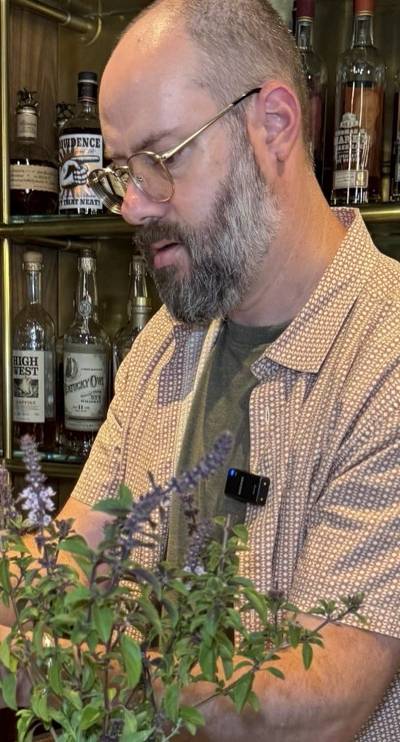
Twelve years into his run at Providence, Kim Stodel has built a bar that wastes almost nothing. We spent a day with him, from the rooftop hives to the bar top, to see how it works. Stodel works with fresh herbs from the rooftop garden behind the Providence bar. — @laeats Providence is the restaurant that made LA fine dining.
Twelve years in, Kim Stodel runs the most sustainable bar program in America from a rooftop garden above Melrose.
Twelve years into his run at Providence, Kim Stodel has built a bar that wastes almost nothing. We spent a day with him, from the rooftop hives to the bar top, to see how it works.
Stodel works with fresh herbs from the rooftop garden behind the Providence bar.
— @laeats
Providence is the restaurant that made LA fine dining what it is: 20 years on Melrose Avenue, three Michelin stars, plus a Michelin Green Star for sustainable practices. Chef Michael Cimarusti's seafood temple. But the quietest revolution in the building isn't in the kitchen. It's at the bar, where bar director Kim Stodel has spent 12 years building what we'd call America's most sustainable bar program. Almost nothing gets thrown away. Almost everything gets a second act.
"Well, no such thing as zero-waste, but we're always striving," Stodel told us. "It means trying to be creative and thoughtful about the choices that I make behind the bar with my fresh ingredients. Being mindful about how things are used, wondering if there's a way to use something that I haven't thought of before."
Resourceful, creative, and driven. His words. Twelve years in, the proof is on the menu.
The roof is a pantry
Stodel checks the pollen tray on one of the rooftop beehives.
— @laeats
A day and a half of bee pollen, harvested on the Providence roof.
— @laeats
Sage and rosemary thriving in the rooftop garden boxes.
— @laeats
The day starts upstairs, above the dining room, where Providence tends a full rooftop garden: African blue basil, lemon verbena, sage, marigold, anise hyssop, purple shiso, globe basil, a fig tree. Before service, the bar team comes up and picks what they'll use that night.
"Lots of places have little herb gardens, but to really utilize it day in and day out, and rely on it, and for us to say, you know, you can only get this here, we grow this, this is our stuff, that's really validating," Stodel said. "It really helps define what the program is all about."
Then there are the beehives. Stodel pulled a tray and showed us about a day and a half's worth of bee pollen, collected as bees pass through a wire grid that brushes the pollen off their legs. He handed some over. It tastes, improbably, like cookie dough.
That pollen becomes the signature of the bar's most popular drink, built downstairs at the bar top.
Honey the bar uses in large volumes, far more than the hives produce. But pollen is another story. "The pollen I can stretch," Stodel said. "There's always more than enough, which is wonderful."
The pollen cocktail
The Bee Sneeze: tequila, fino sherry and citrus with a bee-pollen rim.
— @laeats
Spent citrus, cured and ready for the next glass rim.
— @laeats
Downstairs at the bar, that pollen becomes the Bee Sneeze, the most popular drink Stodel makes and the one his regulars won't let him take off the menu.
The build starts with the rim. He rubs the glass with spent citrus, whatever was peeled that night, lemon, lime, or orange, then rolls it through a mix of bee pollen, fennel pollen, sugar, and salt. The base is pre-batched for service speed: a booze mix of blanco tequila and fino sherry, plus a sour mix of honey, lemon, orange, and lavender. Everything is built for speed, because the bar has to work inside the structure of a tasting menu.
It never leaves the menu. "Since we have those beehives, and the beehives are here all the time, you can always get honey, you can always get orange, you can always get lemon, and those are sort of the core fresh ingredients in that drink," Stodel said. "People love it, so we don't change it, and it really tells a great story about the restaurant."
Everything gets a second act
The Dirty Screaming Viking: a freezer martini on house pickle brine.
— @laeats
Back downstairs, the waste logic runs through every drink we watched him build.
The Dirty Screaming Viking, his dirty martini, starts with a brine made from African blue basil picked that morning, plus cucumber, Fresno pepper, cherry vinegar, house-made soy sauce, salt, sugar, and acid powders, steeped at least 24 hours. The brine goes into a freezer martini of gin and vodka. The vodka isn't there for flavor. "The vodka is more of a lengthener," Stodel said. "You want to keep the proof, but you want to thin out those flavors just a little bit. Instead of diluting with water, we're diluting with booze."
The Santorini Tini is its nonalcoholic mirror: cucumber, dill, and yogurt, clarified overnight until the curds separate and the liquid runs clear, leaving a savory Greek-style brine. The byproduct doesn't get tossed. The seasoned curds get stuffed into Castelvetrano olives. "We have a martini for the people who drink and one for people who don't," Stodel said.
The Electric Margarita repurposes the spent shells of passion fruit after juicing, turning them into a cordial for a tableside margarita. One of his cocktails, he told us, repurposes a byproduct of its own production.
And then there's the citrus. "At the end of the night, every bar in the country will have leftover lemons and limes," Stodel said, opening a container of wedges that had been sitting in sugar for nearly a month. Just sugar and leftover citrus. Through osmosis, the sugar draws out the essential oils and juice, turning into a deeply flavorful syrup. "I think the potential here is pretty great as a sweetener."
The same logic runs through the rest of the menu: snap pea shells seasoning gin, raspberry pulp dried into powder, celery root living three lives across cordials and garnishes, guava pulp dehydrated into fruit leather. None of it reads as compromise. These are among the most considered drinks in the city. Sustainability is the method, not the marketing.
Zero proof, full intent
Fresh Cut Flowers: marigold and lemon verbena soda, carbonated in house.
— @laeats
Three years ago, Stodel launched a nonalcoholic pairing to run alongside the tasting menu. He'd wanted to do it for years but didn't feel capable of honoring the restaurant until the program matured. Now it keeps growing. The bar averages about four NA pairings a night, sometimes eight, and hybrid pairings, where a guest mixes wine and NA courses, are happening more and more.
"It makes perfect sense that we have something for people who don't drink, won't drink, or can't drink," he said. "Everyone wants to be surprised, and we do our best to try and meet that expectation."
The NA drinks get the same roof-to-glass treatment. Fresh Cut Flowers, a soda of marigold and lemon verbena steeped, seasoned, and force-carbonated upstairs, started when the chef told Stodel the marigold was going crazy on the roof and asked if he could make something with it. He could. It was wonderful.
That's the industry point. Most restaurants still treat the NA list as an afterthought, a couple of sodas and a shrug. Providence shows what happens when the same rigor goes into both.
Why it matters
Stodel measures ingredients behind the bar.
— @laeats
Freshly picked African blue basil, washed and ready.
— @laeats
Bars are the highest-waste corner of most restaurants: citrus squeezed and tossed, herbs wilted by midnight, water and ice down the drain. Stodel flipped the supply chain. His market became the kitchen itself and the roof above it. Line cooks save their scraps for him. The garden gets picked daily. The bees do the rest.
Twelve years in, it's no longer an experiment. It's a template. The most sustainable bar program in America isn't a pop-up or a concept. It sits inside a restaurant that already holds Michelin's Green Star, and it's been running for a decade, one pollen-dusted rim at a time.
Reporting from a full-day production visit with Kim Stodel at Providence, October 2026. All quotes from on-camera interviews; cocktail details observed during prep and service. Photos: @laeats production visit. Background: Providence 12th-anniversary tribute to Kim Stodel (Sep 2026); LA Times 20-year Providence feature; Bar Business "No Ingredient Left Behind"; Michelin Guide (3 stars; Green Star).